Long before “internationalization” and “localization” became line items in every software company’s product roadmap, a small community of engineers, linguists, and standards architects met regularly to hash out how computers should represent the world’s writing systems. Their venue was the Internationalization and Unicode Conference — IUC for short — a recurring technical conference organized in partnership with the Unicode Consortium, the standards body responsible for the character-encoding system that underlies virtually all modern text processing.
IUC isn’t widely remembered today, in part because the problem it existed to solve — reliable, consistent text encoding across languages and platforms — was largely solved by the mid-2000s, and the conference wound down as its core technical questions were settled. But the event, and the company that handled its logistics, offer a useful window into how technical conferences were actually run in the era before event-management software existed as a category of its own.
What the Internationalization and Unicode Conference Was
IUC brought together the people building internationalization (often abbreviated “i18n”) and localization (“l10n”) support into operating systems, programming languages, and applications. Sessions covered character encoding, bidirectional text rendering (for languages like Arabic and Hebrew that read right-to-left), font and input-method engineering, and the practical work of adapting software for markets outside its country of origin.
The conference ran under sequential numbering — publicly archived program pages document editions at least into the high twenties, with the 28th edition held in September 2005 in Orlando, Florida, according to materials later published by academic attendees. That numbering, on its own, indicates a conference series that ran for well over a decade, most likely beginning in the early-to-mid 1990s as internationalization first became a distinct engineering discipline.
By the time the series wound down in the mid-to-late 2000s, most of the foundational internationalization problems IUC existed to debate — encoding standardization chief among them — had been resolved. Unicode had become the default text-encoding standard across essentially every major computing platform, and the conference’s reason for existing diminished accordingly.
The Internationalization Problem IUC Existed to Solve
It’s easy to take consistent text rendering for granted today, but the underlying problem was genuinely hard, and it’s worth remembering why a dedicated conference existed to address it. Before Unicode’s widespread adoption, computing systems represented text using dozens of incompatible, often region-specific character encodings. A document created on a Japanese system encoded in Shift-JIS could render as garbled characters on a system expecting ISO-8859-1 or a Windows code page built for Western European languages. Software vendors shipped separate, often incompatible builds for different language markets, and there was no single reliable way to mix multiple languages — say, English, Arabic, and Chinese — in a single document or database field.
Unicode’s core proposal — a single, unified character set covering every writing system, with enough address space to avoid the collisions that plagued the older encodings — was elegant in principle but enormously complicated in practice. Implementing it correctly meant solving problems in font rendering, sorting and collation rules that differ by language and locale, input methods for languages with far more characters than a standard keyboard has keys, and bidirectional text layout for scripts that read right-to-left. Each of these was its own specialized engineering domain, and IUC functioned as the forum where the specialists in each domain compared notes, debated draft standards, and pushed vendors toward consistent implementations.
The stakes were significant. Getting internationalization wrong didn’t just produce cosmetic bugs — it could make software genuinely unusable for entire language markets, corrupt data in ways that were difficult to detect and expensive to fix retroactively, and lock companies out of the fastest-growing regions for computing adoption. That combination of technical difficulty and commercial urgency is what sustained a standalone conference series across roughly a decade and a half of software history.
The Company Behind the Logistics: Global Meeting Services
Organizing a recurring international technical conference requires more than a program committee — it requires someone to run registration, coordinate sponsors and exhibitors, negotiate hotel room blocks, and handle the dozens of operational details that determine whether attendees actually show up and have a good experience. For IUC, at least across several editions, that operator was Global Meeting Services, Inc. (GMS), a professional conference-management company.
Archived IUC program pages — hosted on the Unicode Consortium’s own site — directed attendees to GMS for registration, sponsorship sign-up, exhibitor showcase participation, hotel and travel information, and conference rate schedules. Program materials from that era describe GMS as organizing the Internationalization and Unicode Conferences under a license granted by the Unicode Consortium, with responsibility for registration and conference operations. The operational pattern is exactly what a professional conference-management firm still does today: a standing set of registration, sponsorship, and exhibitor forms, reused and lightly updated for each year’s edition, hosted centrally rather than rebuilt from scratch for every conference.
GMS’s involvement wasn’t limited to IUC. Records also show the company organizing a separate Globalisation Management Strategies Conference series — a related but distinct event apparently focused on the business and process side of taking software global, complementing IUC’s more technical, standards-focused program.
How Conference Registration Actually Worked in the Early 2000s
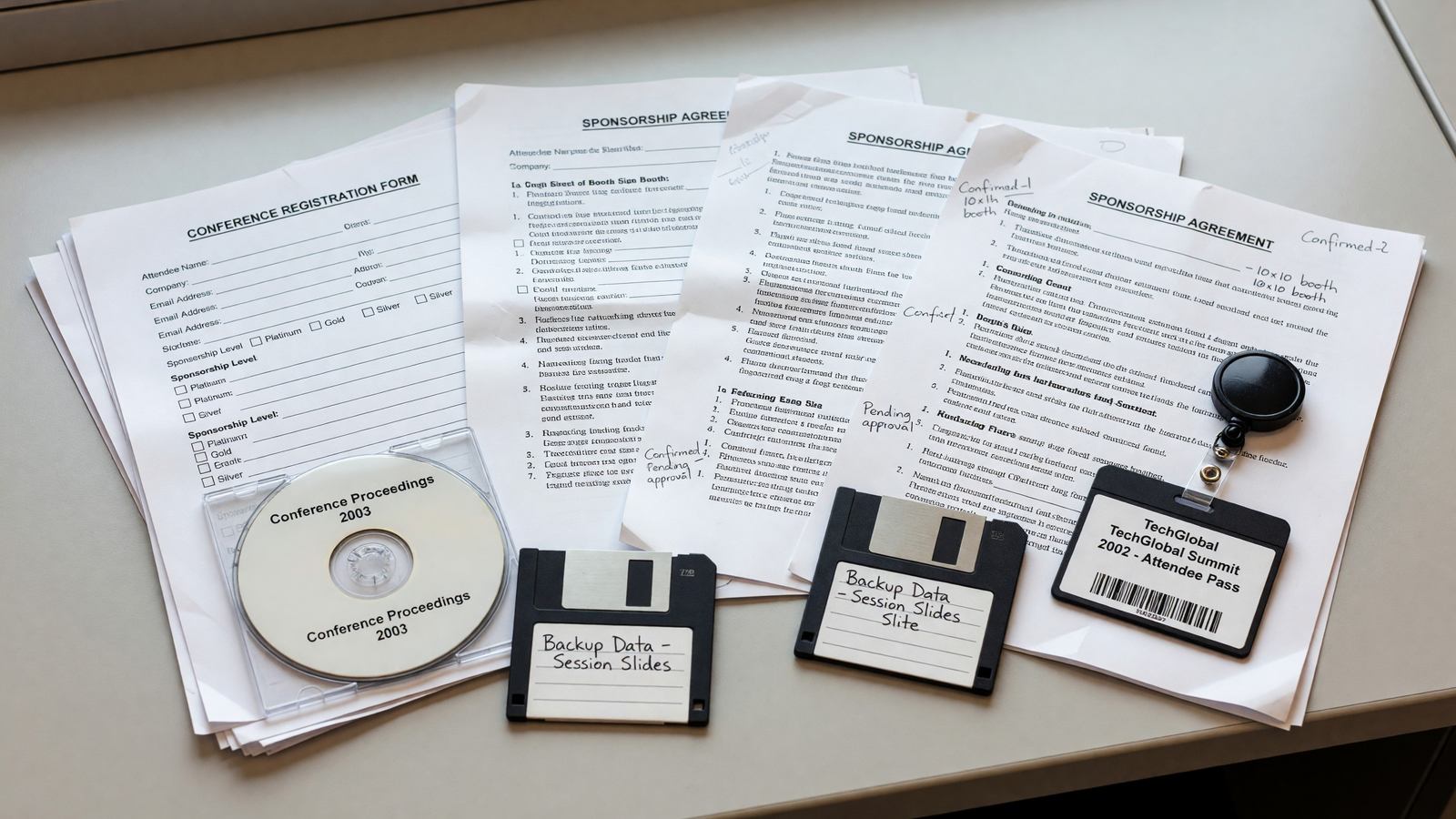
What’s striking, looking at the archived structure of GMS’s registration system, is how manual and form-driven the entire operation was compared to a modern event-technology stack. Each conference edition had its own dedicated registration page, sponsorship page, and exhibitor showcase page — but the underlying registration and payment forms were shared and reused across years, updated in place rather than rebuilt. Sponsor tiers, exhibitor showcase participation, and speaker registration each had their own dedicated form, submitted separately, almost certainly processed at least partly by hand on the back end.
There was no unified attendee database syncing registration, badge printing, and session attendance in real time — the technology to do that at reasonable cost simply didn’t exist yet for an organization of GMS’s size. Sponsor fulfillment, exhibitor logistics, and attendee communications would have run through a combination of email, spreadsheets, and static web forms, coordinated manually by conference-management staff. This wasn’t a deficiency specific to GMS; it was the standard operating model for the entire conference-management industry at the time.
Why This History Is Worth Noting
It would be easy to read this as a footnote — a defunct conference, a since-dissolved events company, a domain name that sat dormant for the better part of two decades. But the operational pattern GMS ran is instructive precisely because so much of it has since been automated.
Every task GMS handled manually or semi-manually in the early 2000s — a standing registration form, sponsor tiers with associated deliverables, exhibitor showcase sign-up, attendee-facing hotel and travel logistics — is now a category of dedicated software. Modern event-technology platforms bundle registration, badge and lead-retrieval, attendee engagement, and sponsor/exhibitor management into single systems, often with real-time reporting that a conference-management firm in 2005 could only have dreamed of.
That shift — from a conference organizer manually running static HTML registration forms to software platforms that manage the entire attendee lifecycle — is, in a sense, the whole story of the modern event-technology industry. Understanding where the industry started makes it easier to evaluate where it actually adds value today, rather than treating every new platform feature as inherently novel.
From Conference History to Conference Technology
That throughline — from manually operated registration forms to today’s event-technology stack — is why this publication exists in its current form: as an editorial resource covering the tools, platforms, and systems that run conferences, tradeshows, and corporate events, alongside coverage of the broader global technology conference circuit.
Readers interested in how the discipline evolved from GMS’s era to the present should see our coverage of registration and ticketing platforms, lead-retrieval and badge systems, and virtual and hybrid event technology — each covering the modern equivalent of a function GMS and firms like it once handled by hand.
Frequently Asked Questions
What was the International Unicode Conference?
IUC was a recurring technical conference, organized in partnership with the Unicode Consortium, focused on internationalization and localization engineering — the work of making software handle the world’s languages and writing systems correctly. It ran for well over a decade, with publicly documented editions at least into the high twenties.
Who organized the International Unicode Conference?
Program materials from at least several editions credit Global Meeting Services, Inc. (GMS) as the conference organizer, handling registration, sponsorship, exhibitor coordination, and attendee logistics. Unicode Consortium staff and volunteer committees set the technical program.
Why did the conference stop running?
Public records don’t document an official end date or reason. The most plausible explanation is that the conference’s core purpose — resolving encoding and internationalization standardization questions — had largely been achieved by the mid-2000s, as Unicode became the near-universal text-encoding standard, reducing the need for the kind of standards-focused gathering IUC provided.
Is Global Conference affiliated with Global Meeting Services or the Unicode Consortium?
No. Global Conference is an independent editorial publication with no affiliation to Global Meeting Services, Inc., the Unicode Consortium, or the International Unicode Conference. This article is a historical account based on publicly available archived materials, not a claim of continuity or succession.